
Application Isolation
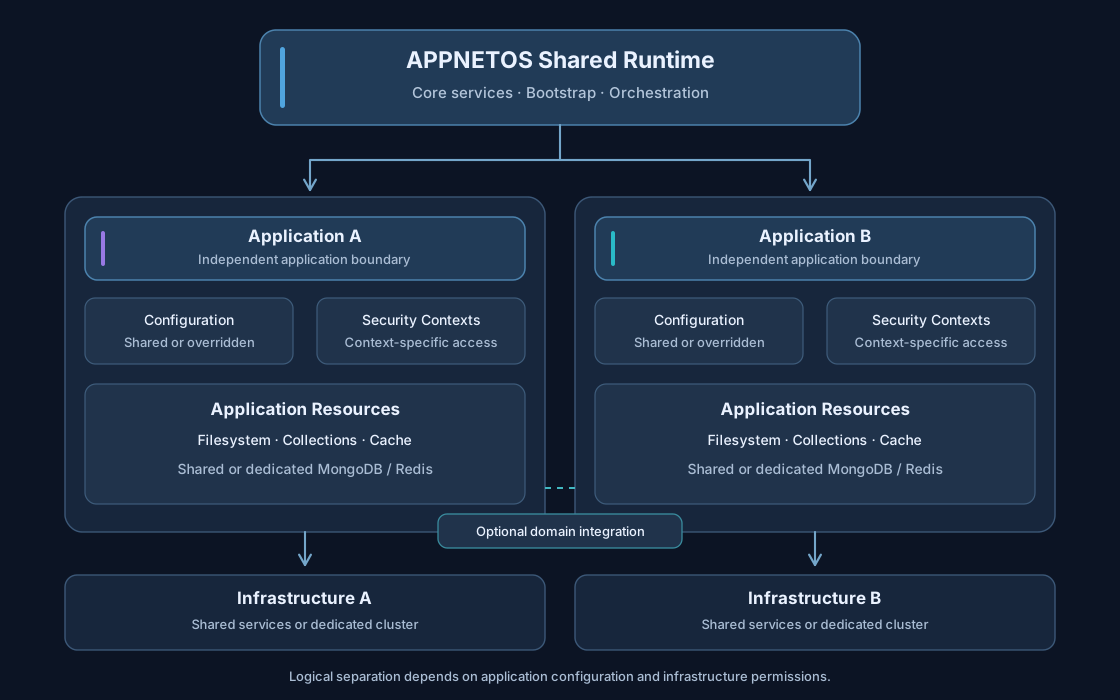
Applications can benefit from a shared APPNETOS runtime while maintaining their own configuration, resources, data connections, and access rules. Shared infrastructure and cross-application integration are choices, not architectural requirements.
Independence by design
APPNETOS applications can share one runtime without becoming a single business application. Each application can own its functionality, context implementations, configuration, resources, and operational responsibilities.
This architecture makes it possible to deploy related business software on a common technical foundation while preserving explicit boundaries between domains and administrative areas.
Configuration and infrastructure boundaries
Applications can adopt central Core settings or supply individual configuration. This includes independent MongoDB connections and databases, dedicated MongoDB clusters, Redis connections, and database-cache configuration.
Shared infrastructure can simplify deployment and maintenance. Dedicated infrastructure can improve separation and allow selected applications to scale or operate independently. Neither choice is universally required.
Context and access boundaries
Application and administration contexts are separate execution areas. Authentication, authorization, REST security, and access to sensitive operations should be configured according to the purpose of each context.
Not every context should expose every dataset or operation. Such restrictions must be enforced by the relevant application and Core security mechanisms and, where stronger isolation is required, by separate database credentials and infrastructure permissions.
Filesystem and resource boundaries
Applications can maintain their own assets, installation resources, configuration, and runtime files. Keeping these resources associated with the owning application reduces accidental coupling and simplifies updates, deployment, and maintenance.
Filesystem separation in the application structure is a logical boundary. Operating-system permissions and container or host isolation are separate deployment controls.
Application aliases
An application alias allows an origin application to be reused as a separate application instance. The alias can have its own configuration, routes, resources, and mapped data collections rather than implicitly sharing the origin application’s operational data.
Alias-specific class mapping and installation behavior require deliberate configuration. Their detailed rules belong in the dedicated application customization documentation.
Controlled integration and shared domains
Isolation does not prevent collaboration. Applications may intentionally reuse shared domain models, services, Core Apps, or business components through customization. The goal is controlled integration: shared logic where it reduces duplication, independent ownership where it protects clarity and maintainability.
Security boundaries and deployment responsibility
Logical application isolation is not the same as operating-system, process, network, or database isolation. Applications running in the same PHP runtime can share process-level capabilities. Separate clusters or containers only provide stronger boundaries when their credentials, networks, permissions, and deployment settings enforce them.
Production deployments should apply least-privilege credentials, appropriate network restrictions, context-specific authorization, secure secrets management, and separate resources where required by the threat model. APPNETOS provides architectural flexibility; the chosen deployment determines the strength of the resulting isolation.