
Business Core
One Business Model. Unlimited Applications.
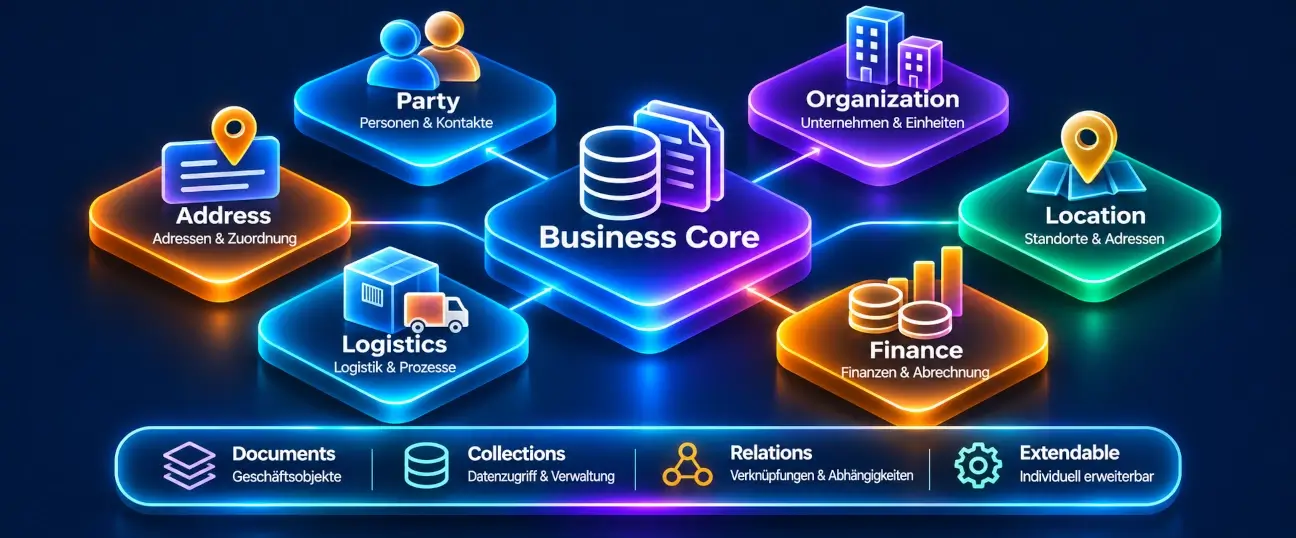
Stop reinventing business data structures. Start building business software. APPNETOS Business Core provides reusable documents and prepared collections for familiar business concepts, so new applications can build on a common foundation and focus on the work that makes their business processes unique.
What is Business Core?
Business Core is a library of reusable domain-oriented document definitions and corresponding collection base classes. It covers common business concepts such as addresses, customers, organizations, locations, logistics and finance.
These classes provide a starting point for application-specific models. They are not a standalone CRM, ERP or commerce application, and they do not automatically define the database configuration for every application. Your application extends the appropriate base classes and connects its concrete documents and collections through the APPNETOS mapping system.
Stop rebuilding the same business models
Customers need addresses. Companies have organizational structures. Warehouses and carriers appear in logistics workflows. These concepts return in project after project — often with almost identical data requirements. Recreating them each time introduces duplicated work, inconsistent terminology and unnecessary maintenance.
Ready-made foundations
Start with prepared business documents and collection bases instead of defining every common property and class from scratch.
Extend, don't duplicate
Add application-specific properties, methods and business rules through your own derived classes.
Maintain a common vocabulary
Build different applications on recognizable domain concepts, reducing avoidable differences between their data models.
Designed for domain-driven development
Domain-Driven Design encourages software to express the language and concepts of the business domain. Business Core supports this approach by organizing reusable models around meaningful concepts — Customer, Company, Address, Warehouse and more — rather than around a particular user interface or application.
A common foundation does not mean every domain must use identical rules. Different bounded contexts can extend or specialize their models where their requirements differ. Business Core supplies reusable definitions; the application remains responsible for its own domain behavior and boundaries.
Extend the model. Keep the foundation.
Business Core document and collection classes are designed for inheritance. An application can derive its own classes, retain the provided properties and add whatever its domain requires. The concrete application classes also establish the required document-to-collection mapping.
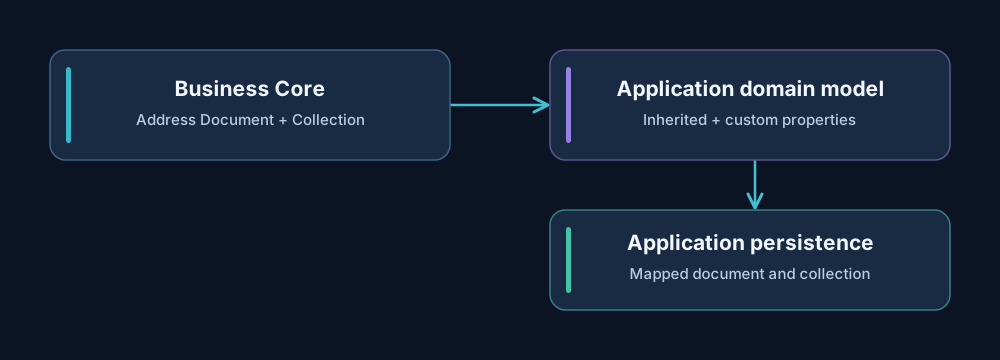
For example, a customer document can inherit the common customer properties and add an application-specific customer number or loyalty status. The base definition stays reusable, while the application owns its extensions and persistence configuration.
The individual model pages provide the concrete PHP integration pattern and a complete property reference. Start with Address or Customer.
One domain foundation across multiple applications
APPNETOS Class Mapping makes it possible to resolve shared application domain classes across application boundaries. A CRM, an ERP and a commerce application can therefore be designed to use the same mapped customer or address model instead of maintaining three independently defined versions of that model.
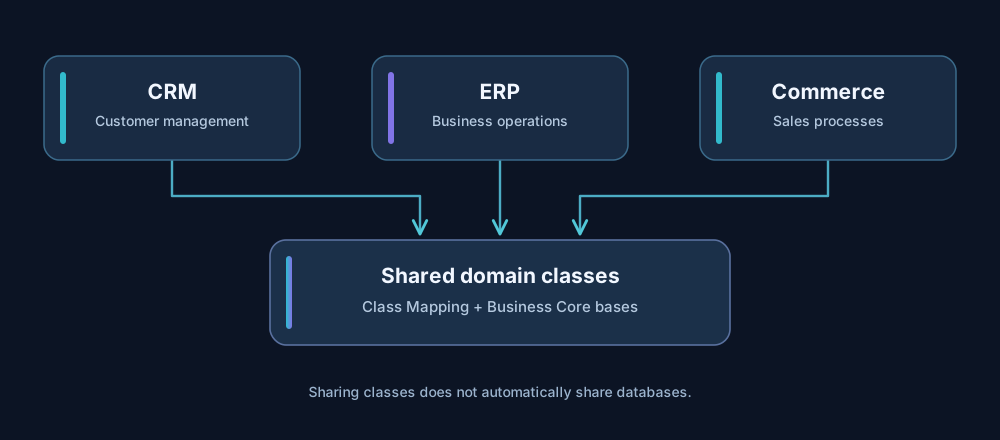
Shared classes encourage a common vocabulary and reduce duplicate implementations. They do not automatically mean shared storage, identical permissions or unrestricted access to each other's data. Data ownership, persistence and context boundaries remain deliberate application architecture decisions.
Learn more about Class Mapping and Application Isolation.
Documents and collections: one integration model
Every supported business model provides a document base and a prepared collection base. The document describes the reusable business data; the collection provides the corresponding persistence-side foundation. Applications derive both classes and connect their concrete implementations using APPNETOS database mapping annotations.
The Business Core reference deliberately focuses on documents and their properties. Collection bases follow the same integration pattern, so separate collection reference pages would repeat the same information. Each document page includes the integration example for both classes.
Consistent models. Less integration friction.
When applications agree on their core business concepts, teams can spend less time translating between slightly different structures. Shared models can simplify maintenance, make cross-application integrations easier to reason about and provide a stable starting point for future applications.
This consistency is a design advantage, not an automatic guarantee of compatibility. Applications still need explicit contracts for validation, data exchange, permissions and version changes.
Build business software, not the same foundations again.
Business Core is designed to grow with the APPNETOS ecosystem. A shared library of business definitions helps each new application begin with more than an empty data model — without taking away the flexibility to implement its own processes and domain rules.
One Core. Unlimited Business Software.