
Autowire
Annotation-based property injection and lifecycle method registration for APPNETOS runtime objects.
Overview
Core\Autowire\Base resolves supported APPNETOS PHP attributes on an existing object.
It injects values into annotated properties and registers annotated shutdown methods.
The resolver is used as part of the APPNETOS runtime object lifecycle and is closely
connected to the Core
Registry.
Autowiring separates the declaration of dependencies and runtime values from the code that retrieves them. The resolver does not replace the Registry's responsibility for class resolution, object creation or shared-object management.
Context Availability
Context Independent
The shared implementation is located at
appnetos/shared/src/Core/Autowire/Base.php.
The resolver can be used in all implemented APPNETOS contexts. However, the availability
of an annotation's value source depends on the active context: for example, HTTP request,
cookie and session services must be available for the corresponding injections.
Architecture & Processing
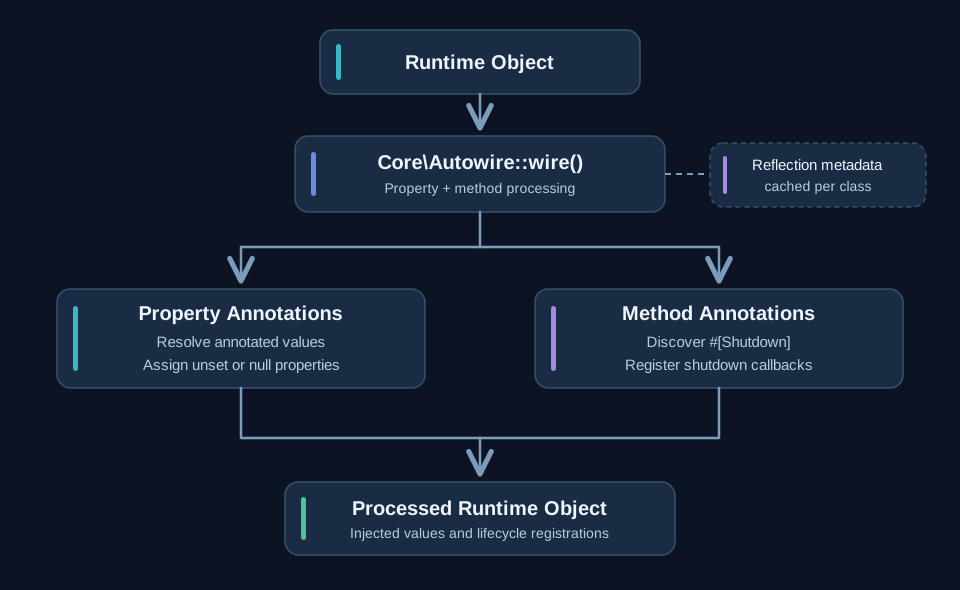
wire() processes properties first and methods second. The resolver examines
the object's class hierarchy using PHP Reflection and builds reusable annotation
definitions. Supported property annotations resolve values from the Registry, runtime,
configuration, environment, server, session, cookie, request, POST, GET or translations.
A property is assigned only when it is not initialized or its current value is
null. Already initialized, non-null values are preserved.
Method processing currently recognizes #[Shutdown] and registers the
annotated method with the shutdown controller when that controller is present in
the Registry.
Reflection Caching
The resolver maintains separate static caches for property and method reflection definitions, keyed by the concrete PHP class. The caches avoid scanning the same class hierarchy repeatedly during the current runtime. They store annotation metadata, not a permanent cache of all injected property values.
The #[Cached] property annotation is a distinct mechanism. In the current
implementation, request-scope cached values are stored with a TTL; other scopes fall
back to resolving the value without this request-cache shortcut. Its configuration
and behavior will be described in the separate annotation documentation.
Public API Overview
Only the public API is listed here. Full signatures, parameters, return types, exceptions and DocBlocks belong to the automatically generated Developer Class Reference.
| Method | Description |
|---|---|
wire() |
Process supported property and method annotations on an existing object. |
clearReflectionCache() |
Clear the cached property and method reflection definitions. |
Annotations
Autowire is an annotation consumer, not the definition of every APPNETOS
annotation. Property injection annotations cover dependencies, configuration and
runtime values, HTTP inputs, cookies, sessions and translations. The
#[Cached] annotation modifies property-value resolution, while
#[Shutdown] is handled as a method annotation.
Other annotations, such as #[Shared], are interpreted by different
Core components. A dedicated Core Annotations documentation group
will explain the annotations individually and identify their processing components.
Limitations & Extension Rules
- Autowiring depends on services available in the active context.
- It does not overwrite properties with an existing non-null value.
- Shutdown registration is skipped when the shutdown controller is absent from the Registry.
- Invalid or conflicting annotation definitions may raise annotation or reflection exceptions.
Core\Autowire\Basecannot be replaced through the APPNETOS Class Extension System.