
Bootstrap & Configuration
How APPNETOS starts its runtime, selects the active context, initializes Core components, and resolves platform configuration.
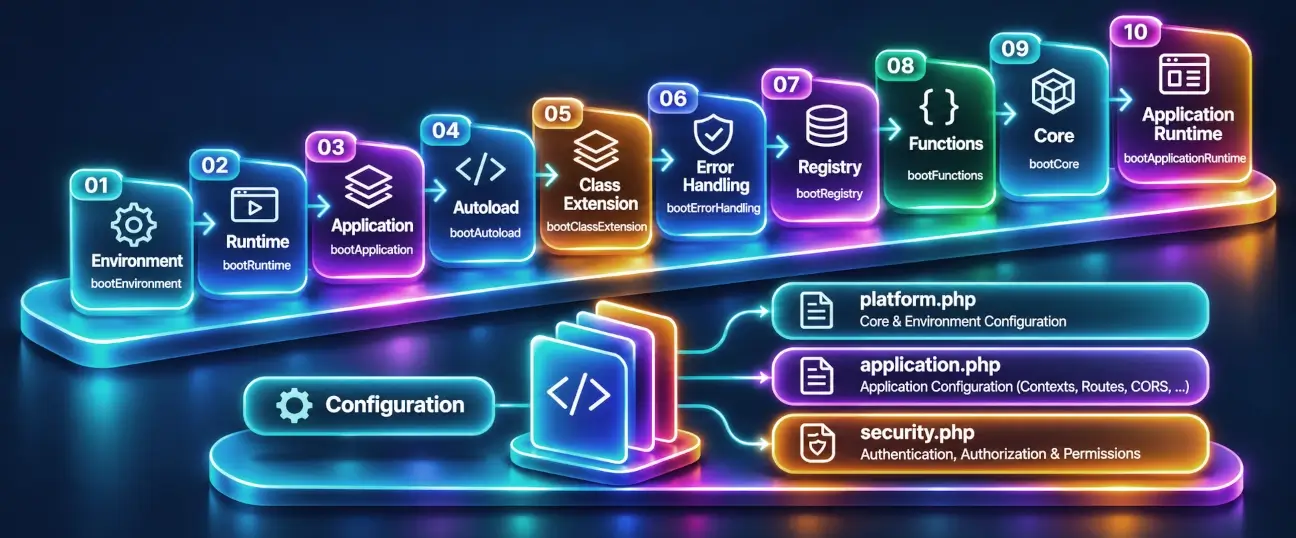
APPNETOS uses a shared Core with context-specific initialization. The bootstrap establishes the runtime before application services are used. Configuration then provides the infrastructure and behavior required by the selected application and context.
Overview
Bootstrap and configuration are related but distinct responsibilities. The bootstrap determines what runs and in which context. The configuration controller determines which settings apply to that runtime.
| Component | Responsibility |
|---|---|
| Bootstrap Sequence | Describes the ordered initialization of the APPNETOS runtime and its Core components. |
| Process Bootstrap | Validates command-line invocations, prepares process input, and starts the central bootstrap
for cmd and worker.
|
| Platform Configuration | Loads global, environment-specific, and application-specific settings into typed context configuration properties. |
Runtime Contexts
The shared Core supports separate execution contexts, including app, admin,
rest, admin-rest, cmd, and worker. Each context
initializes the Core components needed for its responsibilities rather than starting an identical set of
HTTP services for every execution path.
For example, command and worker processes do not require the regular HTTP request, response, session, routing, and rendering pipeline. Context selection and initialization are explained in the detailed bootstrap pages.
For the architectural background, see Application Contexts and Application Isolation.
Documentation
Start with the bootstrap sequence to understand runtime initialization, then explore process execution and platform configuration.
Configuration Principles
APPNETOS reads active configuration from platform/config/. Configuration is layered: global
files are followed by optional environment-specific and application-specific files. Recognized settings
are mapped to typed properties and validated.
- Shared infrastructure: MongoDB and Redis settings are defined under
contexts.shared. - Context-specific behavior: App and admin configuration values are defined
separately under
contexts.appandcontexts.admin. - Environment overlays: Development and production can override common settings without changing the configuration loader.
- Installation separation: Custom platform installation resources are copied to the
active platform directory; the runtime does not read them directly from
custom/.
The Configuration Reference documents supported keys, types, defaults, and their behavior.
Recommended Reading Order
- Bootstrap Sequence — understand how the runtime starts.
- Process Bootstrap — understand command and worker startup.
- Platform Configuration — understand configuration loading and operations.